The Neurospicy Guide to Marriage Ceremonies: 5 Sensory-Accommodating Ceremony Tips
Alright, let’s talk about one of the most common questions I get from my neurodivergent clients - how do I tolerate my wedding ceremony when it sounds like my version of hell?!
Well the good news is, it doesn’t actually have to be that way - your ceremony does NOT have to be a one-size-fits-all sensory overload.
If you or your partner (and possibly half your guest list!) are neurodivergent—maybe you're ADHD, Autistic, a trauma survivor, or just someone who genuinely hates bright lights, loud noises, and endless standing around—planning a wedding can feel super overwhelming.
The truth? Your wedding ceremony should be a moment of genuine connection, not a 30-minute battle against your own brain and body. As a neurodivergent celebrant myself, I specialise in making sure the vibe is on point and all our nervous systems stay as regulated as possible.
Here are my five must-know sensory-accommodating tips for crafting a comfortable wedding ceremony that doesn’t sacrifice meaning and joy and that feels genuinely good.
1. The Great Debate: Indoor vs. Outdoor
The Tip: When choosing your location, think beyond beautiful photos and prioritise what’s going to feel good. Consider whether you want to be indoors vs. outdoors and how things like wind, heat, rain, and unexpected noise will impact your ceremony experience.
Why it matters: Heat stress, blustery wind, getting drenched through your outfit or getting overwhelmed by the noises of a busy city location can all derail your focus and comfort and that of your guests. If your Plan A is an outdoor location, you should absolutely choose an indoor or undercover Plan B but please, for the love of all that is unholy, don't pick a location that you actually hate! If you despise your shit-weather option, the stress having to switch to it will be that much worse. Pick a Plan B you can genuinely embrace, so the decision on the day is about seeking comfort and ease rather than avoidance.
2. Music, Noise, and A Sensory Toolkit
The Tip: Think critically about the role of music—not just the playlist itself, but the vibe you’re going for, the volume you crank it at, and where the speaker gets located in terms of proximity to you and your guests.
Why it matters: Blasting your fave heavy metal music might be normal for you and some of your mates, but intolerable for others. Having a speaker placed right next to anyone with auditory processing needs can stop them from engaging with your ceremony at all. But fear not, there’s a super simple fix - encourage guests to bring and use their Loops if they have them, and consider offering high-quality earplugs or even fidget toys on arrival. This is an incredible sign of your genuine inclusion and care, and hell feel free to use them yourself - no professional celebrant should ever stop you from stimming through your own ceremony. Let music set the mood, not dominate the moment.
3. The Goldilocks Length: Keep it Short and Sweet
The Tip: Consider the actual length of your ceremony. Most people (neurotypical or not) struggle to focus for longer than 30 minutes. You and your guests may have even shorter attention spans, or find that a long time to stay still and/or chill.
Why it matters: If the ceremony drags, energy flags, focus drifts, and the main event becomes something everyone is just trying to survive. Not a vibe! I guarantee you, a deeply personalised, well-written 15-20 minute ceremony will always feel more meaningful and engaging than a drawn-out 60-minute epic. Ask your celebrant exactly how long your ceremony will be, and don’t be afraid to tell them how long you want it to be based on your own tolerance for having all eyes on you - it can be tough being perceived for that long! My general rule - keep it snappy, keep it awesome.
4. Public Speaking? Nope! Minimise Spotlight Stress
The Tip: If the thought of public speaking makes your palms sweat, chat to your celebrant about your concerns. There are SO MANY ways to do things differently.
Why it matters: The great thing about modern, civil ceremonies is we are allergic to bullshit rules and traditions. Want to avoid the spotlight as much as possible? That’s totally YOUR call - it’s YOUR day for crying out loud! Try these alternatives:
Silent Vows: Saying them quietly, just in front of the legally-required two witnesses and your celebrant. Still legal, but much less scary for some people.
Follow the leader: Your celebrant leads and you follow, repeat after me style - I’ll say what you want to express, and you simply either repeat it verbatim after me, or confirm your agreement to what I’ve just said.
The Private Promise: You can move your non-legal vows/promises out of the ceremony entirely and consider doing them privately before or after your ceremony - some couples choose to do this as part of a first look moment before their ceremony, which can help to reduce nerves significantly. I’ve also had couples exchange heartfelt written letters with their beloved instead of saying any words out loud. Pick what makes you comfortable, your celebrant is a professional talker anyway so if you want to leave it all to them, just do it!
5. Build in A Decompression Break
The Tip: Immediately after your ceremony, schedule a decompression break to allow for nervous system regulation.
Why it matters: After a high-stimulus, high-emotion ceremony and the huge dopamine, endorphin and adrenaline dumps you’ve endured, your nervous system is working overtime and for neurodivergent folk, that can feel incredibly unpleasant or even unsafe. A decompression break can help you come down a bit afterwards, and actually re-connect and co-regulate with your beloved, just the two of you. What this ‘break’ could look like:
Private and Hidden: Away from the main crowd, in a room with no public access at your venue or in a car for example.
Stocked Up: Make sure it has your favourite drink and a snack, fidgets or comfort tools if you need them, space to stim or do breathwork or whatever works best for you.
Low Sensory: Quiet, calm, a soft gentle place to sit, and focused only on the two of you reconnecting before you dive back into the party.
Ready to ditch the traditional stress?
Ready to chat with a celebrant who gets it thank to a wicked combo of lived experience and having married lots of ND couples? I specialise in crafting ceremonies that are genuinely inclusive and supportive of every kind of brain.
Hit me up and we can discuss how I can build a sensory-accommodating ceremony that's genuinely YOU.
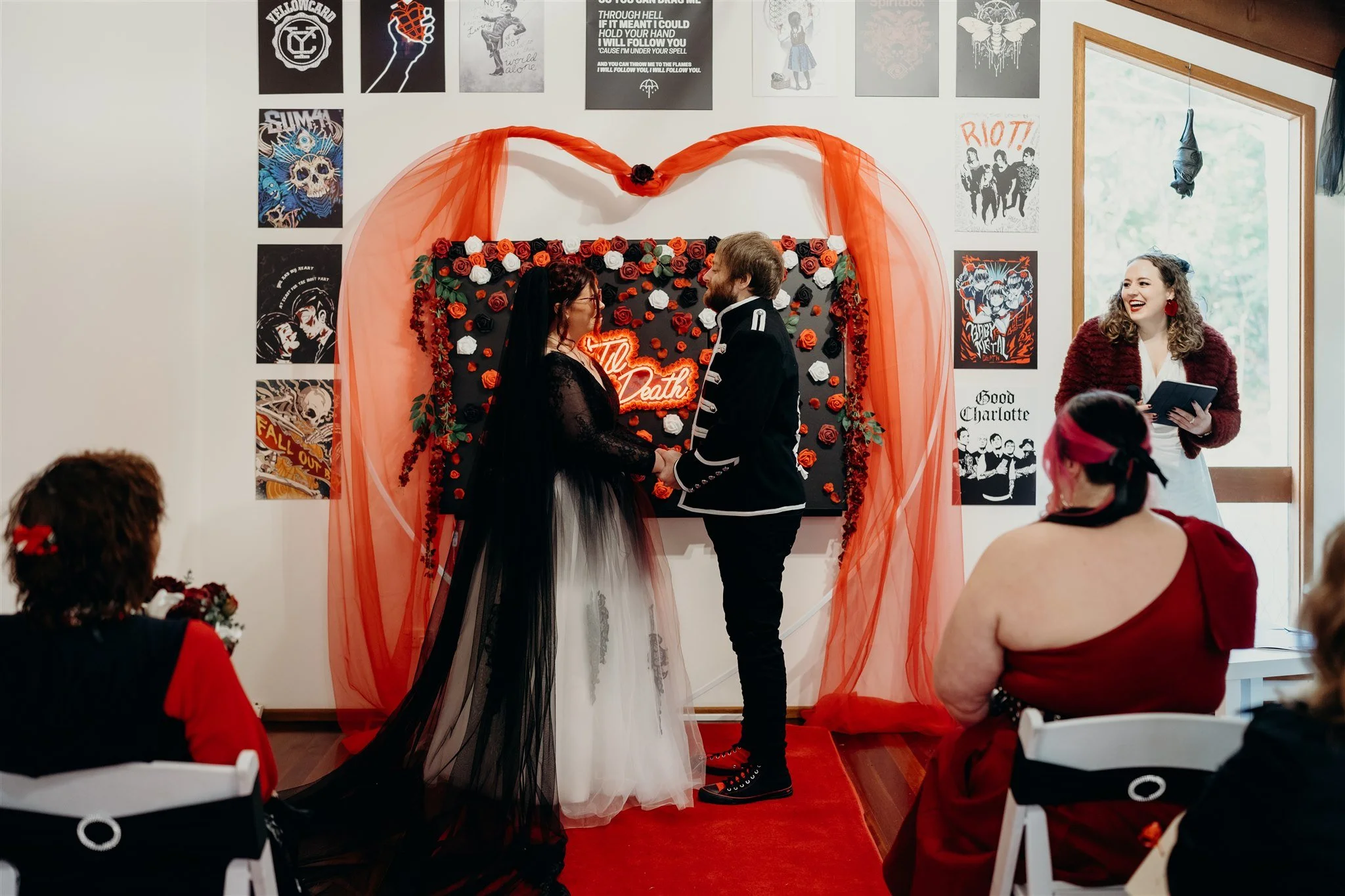
If this wedding looks like a lot, you might be interested to know that it was one of my most neurodivergent-friendly ceremonies ever! Guests were offered earplugs and were warned in advance about the loud emo playlist we were using, and we kept it to 25 minutes. Matt and Nikita then escaped to a quiet room for 15 minutes to eat snakes and drink water and absorb the moment they had just shared. Photo credit: Hayley Morgan Weddings